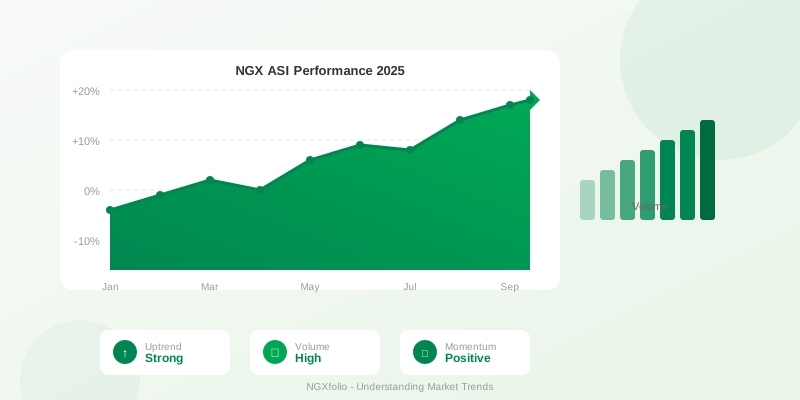
The Nigerian Exchange (NGX) presents unique opportunities for investors who understand how to read market trends. Unlike developed markets with decades of historical data, the NGX requires investors to understand local dynamics, sector rotations, and the factors that move Nigerian stocks.
What Are Market Trends?
A market trend is the general direction in which a stock or the overall market moves over time. Understanding trends helps investors:
- Time entries: Buy when trends are favorable
- Manage risk: Identify when to exit positions
- Allocate assets: Shift between sectors based on momentum
- Set expectations: Understand realistic return projections
💡 Key Insight
NGX trends often follow fiscal year patterns, with increased activity around budget announcements, monetary policy changes, and corporate earnings seasons.
Types of Trends
1. Uptrend (Bull Market)
- Oil prices rise, boosting sentiment in energy-related stocks
- Foreign portfolio investors increase holdings
- Positive economic data is released
- Quarterly earnings exceed expectations
2. Downtrend (Bear Market)
Characterized by lower highs and lower lows. NGX downtrends typically result from:
- Policy uncertainty or interest rate hikes
- Global market sell-offs
- Currency depreciation concerns
- Corporate governance issues
3. Sideways (Consolidation)
When prices move within a defined range without clear direction. This often precedes significant breakouts.
Reading Stock Charts
Chart analysis helps visualize trends. Here are the most common chart types used by NGX investors:
📈 Line Chart
Shows closing prices connected by a line. Best for identifying long-term trends.
Key Chart Patterns on NGX
1. Head and Shoulders
A reversal pattern that can signal trend changes. Watch for this around major resistance levels on heavily traded NGX stocks.
2. Double Top/Bottom
Indicates resistance (top) or support (bottom) levels. Common in NGX banking stocks during profit-taking periods.
3. Ascending Triangle
Bullish continuation pattern often seen in NGX during accumulation phases before earnings announcements.
Volume Analysis
Volume confirms trends. On the NGX:
- High volume on updays: Strong buying pressure (bullish)
- High volume on downdays: Strong selling pressure (bearish)
- Low volume moves: May indicate false breakouts
📊 NGX Volume Tip
NGX average daily volume is lower than developed markets. A 2x increase in volume is more significant on NGX than on NYSE or LSE.
Sector Rotation
Understanding which sectors lead helps predict market direction:
Leading Sectors
- Banking: Often leads due to high index weight
- Telecommunications: MTN drives sector movement
- Consumer Goods: Defensive play during uncertainty
Lagging Sectors
- Oil & Gas: More correlated to oil prices than local sentiment
- Industrial: Economic sensitivity indicator
Using Moving Averages
Moving averages smooth price data to reveal trends:
- 50-day MA: Short-term trend
- 200-day MA: Long-term trend
- Golden Cross: 50-day crosses above 200-day (bullish)
- Death Cross: 50-day crosses below 200-day (bearish)
Trend Indicators for NGX
1. Relative Strength Index (RSI)
Measures overbought/oversold conditions. RSI above 70 suggests overbought; below 30 suggests oversold.
2. MACD (Moving Average Convergence Divergence)
Shows momentum changes. Useful for identifying trend reversals.
3. Bollinger Bands
Shows volatility. Price touching upper band may indicate overbought; touching lower band may indicate oversold.
Practical Application with NGXfolio
Track market trends using NGXfolio's features:
- Monitor portfolio performance against NGX ASI index
- Set price alerts for key support/resistance levels
- Track sector performance through individual stock movements
- Export data for deeper analysis in Excel
Common Trend Mistakes
- Fighting the trend: Don't short in an uptrend or buy in a downtrend
- Ignoring volume: Always confirm trends with volume
- Overtrading: Trends take time to develop
- Recency bias: Recent performance doesn't guarantee future results
"The trend is your friend until it bends." — Old Wall Street adage
Conclusion
Understanding market trends takes practice. Start by identifying the overall market direction, then analyze individual stocks within that context. Use NGXfolio to track trends and make informed decisions.
Ready to apply these concepts? Open NGXfolio to track your portfolio →